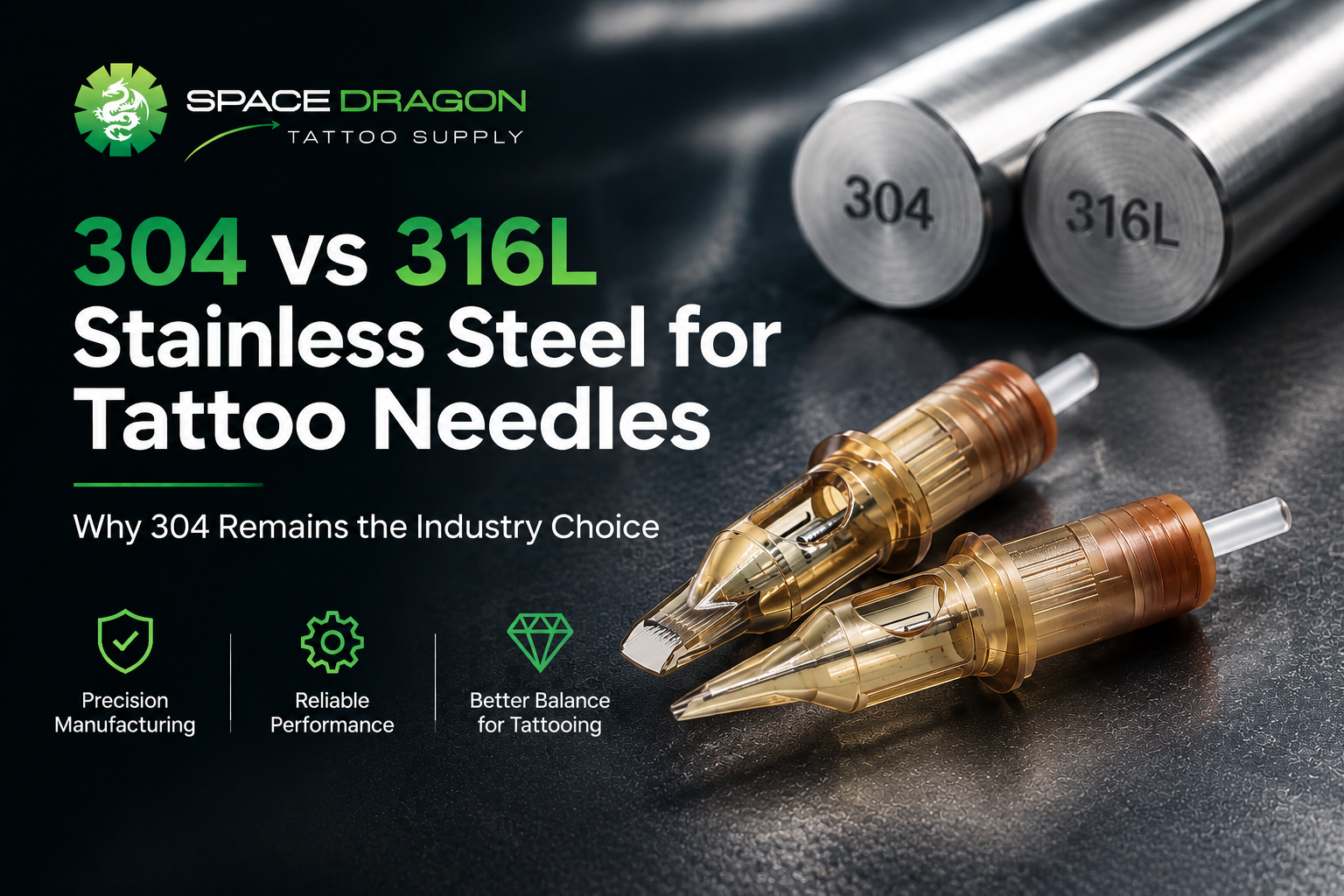
304 vs 316L Stainless Steel for Tattoo Needles: Why 304 Remains the Industry Choice
Introduction
When choosing materials for tattoo needles, many people naturally assume that 316L stainless steel must be better than 304 stainless steel because it is often associated with medical devices, higher corrosion resistance, and a higher price.
However, in precision tattoo needle manufacturing, material selection is not simply about choosing the most expensive option.
The real question is:
Which material provides the best balance of hardness, elasticity, processing performance, precision, and reliability for tattoo needle production?
That is why many professional tattoo needle manufacturers continue to use 304 stainless steel as the preferred material for cartridge needles.
Understanding 304 and 316L Stainless Steel
Both 304 and 316L are high-quality austenitic stainless steels widely used in precision manufacturing.
304 Stainless Steel
304 stainless steel is one of the most commonly used stainless steels worldwide.
Its advantages include:
- Excellent corrosion resistance
- Good mechanical strength
- Stable processing performance
- High consistency during wire drawing and needle forming
- Excellent balance between hardness and flexibility
Because tattoo needles require extremely precise shaping, polishing, and alignment, the processing characteristics of 304 make it highly suitable for needle production.
316L Stainless Steel
316L stainless steel is known for its improved corrosion resistance due to the addition of molybdenum (Mo).
Compared with 304, 316L provides:
- Higher resistance to chloride environments
- Better corrosion resistance in harsh chemical conditions
- Excellent biocompatibility
For applications such as surgical implants and long-term medical devices inside the human body, 316L has clear advantages.
However, tattoo needles are different.
Tattoo cartridges are single-use disposable products, and the needle does not remain inside the body for long periods.
Therefore, the advantages of 316L are not always directly transferable to tattoo needle performance.
Why Do Many Tattoo Needle Manufacturers Choose 304 Instead of 316L?
1. Tattoo Needle Performance Depends More on Precision Manufacturing Than Material Grade
A tattoo needle is not simply a piece of metal.
The final performance depends on many factors:
- Needle diameter accuracy
- Needle grouping consistency
- Taper design
- Surface polishing quality
- Needle alignment
- Elasticity and vibration control
- Manufacturing process stability
A well-manufactured 304 needle can outperform a poorly processed 316L needle.
The material is only one part of the complete production process.
2. 304 Provides Better Processing Characteristics for Needle Manufacturing
Tattoo needles require multiple precision processes:
- Wire drawing
- Cutting
- Grinding
- Welding
- Grouping
- Polishing
- Inspection
304 stainless steel has excellent forming and processing characteristics, allowing manufacturers to achieve:
- Stable needle geometry
- Consistent needle tips
- Smooth surface finishing
- Reliable production efficiency
For mass production of tattoo cartridges, manufacturing stability is extremely important.
3. The Hardness and Flexibility Balance Is Critical
A tattoo needle needs a very specific balance:
- Hard enough to maintain a sharp needle tip
- Flexible enough to reduce excessive vibration
- Stable enough for smooth ink flow and controlled penetration
316L has excellent corrosion resistance, but its advantages do not necessarily mean better tattooing performance.
For tattoo applications, the mechanical properties and processing quality of the final needle are more important than simply choosing a higher-grade stainless steel.
4. Corrosion Resistance Is Not the Main Limitation in Disposable Tattoo Needles
316L is widely recognized for superior corrosion resistance, especially in environments with prolonged exposure to body fluids or chemicals.
However, tattoo cartridges are:
- Sterile
- Individually packaged
- Used once
- Not implanted permanently
A high-quality 304 stainless steel needle already provides sufficient corrosion resistance for this application.
The key requirements are:
- Sterility
- Precision
- Sharpness
- Consistent performance
Not long-term corrosion resistance inside the human body.
5. Choosing 304 Is an Engineering Decision, Not a Cost Reduction
Some people believe manufacturers choose 304 simply because it is cheaper than 316L.
This is a misunderstanding.
A professional manufacturer chooses materials based on:
- Application requirements
- Manufacturing performance
- Product reliability
- User experience
Using 316L does not automatically create a better tattoo needle.
Without precise manufacturing technology, even premium materials cannot guarantee superior performance.
What Matters More Than 304 or 316L?
For professional tattoo artists, the most important factors are:
Needle Tip Precision
A sharper and more consistent needle creates better line quality and smoother shading.
Surface Treatment
A well-polished needle reduces unnecessary skin trauma and improves pigment flow.
Manufacturing Control
Strict quality control ensures every cartridge performs consistently.
Sterilization Process
A reliable sterilization process is essential for safe tattoo procedures.
Conclusion: The Best Material Is the Right Material
316L stainless steel is an excellent material with outstanding corrosion resistance, especially for long-term medical applications.
However, for disposable tattoo cartridge needles, 304 stainless steel remains one of the most widely selected materials because it offers the ideal balance of precision, mechanical performance, processing stability, and reliability.
The quality of a tattoo needle is not determined only by the number written on the material certificate.
It is determined by:
the material + manufacturing technology + precision control + quality inspection.
At Spacedragon, we focus on precision manufacturing and continuous improvement to ensure every cartridge needle delivers consistent performance for tattoo professionals worldwide.
Frequently Asked Questions About 304 and 316 Stainless Steel Tattoo Needles
1. Is 316 stainless steel better than 304 stainless steel for tattoo needles?
Not necessarily.
316 stainless steel is well known for its higher corrosion resistance due to the addition of molybdenum. It is commonly used in applications where materials require extended exposure to harsh environments, such as certain medical and marine applications.
However, tattoo cartridge needles are single-use disposable products. The actual performance of a tattoo needle depends more on:
- Needle precision
- Surface polishing quality
- Needle elasticity
- Grouping consistency
- Manufacturing control
For tattoo needle applications, 304 stainless steel provides an excellent balance of mechanical performance, processing stability, and reliability, which is why it remains widely used in professional tattoo needle manufacturing.
2. Why do many tattoo needle manufacturers choose 304 instead of 316L stainless steel?
The reason is not simply because 304 is cheaper.
Professional manufacturers select materials based on application requirements.
304 stainless steel offers:
- Excellent strength and flexibility balance
- Stable processing performance during needle production
- Reliable polishing and shaping results
- Consistent performance in disposable tattoo cartridges
For tattoo needles, precision manufacturing has a greater influence on the final product performance than choosing a higher corrosion-resistant material.
3. Can Spacedragon manufacture tattoo needles using 316L stainless steel?
Yes, Spacedragon can provide 316L stainless steel tattoo cartridge needles according to specific customer requirements.
However, based on our manufacturing experience, we generally do not recommend 316L stainless steel as the standard material for tattoo cartridge needles.
This is not because 316 stainless steel is inferior. In fact, 316 is an excellent stainless steel material.
The reason is that the additional corrosion resistance of 316 does not provide a significant advantage for a single-use tattoo needle, while 304 already meets the requirements for:
- Precision production
- Needle sharpness
- Mechanical stability
- Consistent tattoo performance
For most professional tattoo applications, we believe 304 stainless steel is the more balanced engineering choice.
4. Does 316 stainless steel make tattoo needles safer?
Not necessarily.
The safety and reliability of tattoo needles depend on a complete manufacturing system, including:
- High-quality raw materials
- Precision manufacturing processes
- Strict quality inspection
- Professional sterilization
- Secure packaging
The stainless steel grade alone does not determine the safety or performance of a tattoo cartridge.
5. What matters more than stainless steel grade for tattoo needles?
For professional tattoo artists, important factors include:
- Needle tip sharpness
- Needle grouping accuracy
- Smooth ink flow
- Stable needle movement
- Consistent cartridge quality
A well-manufactured 304 stainless steel needle can provide excellent tattoo performance when combined with advanced production technology and strict quality control.
6. Should tattoo brands choose 304 or 316L stainless steel for OEM production?
For most tattoo brands, distributors, and wholesalers, we recommend 304 stainless steel.
It provides the right balance between:
✓ Performance
✓ Manufacturing consistency
✓ Reliability
✓ Production efficiency
If a customer has a specific market requirement or material preference, Spacedragon can also support customized production with 316 stainless steel.
Contact Spacedragon today to discuss your requirements.
📩 Email: mira@spdra.com
🌐 Website: www.spdra.com
💬 WhatsApp: +86 13606216251