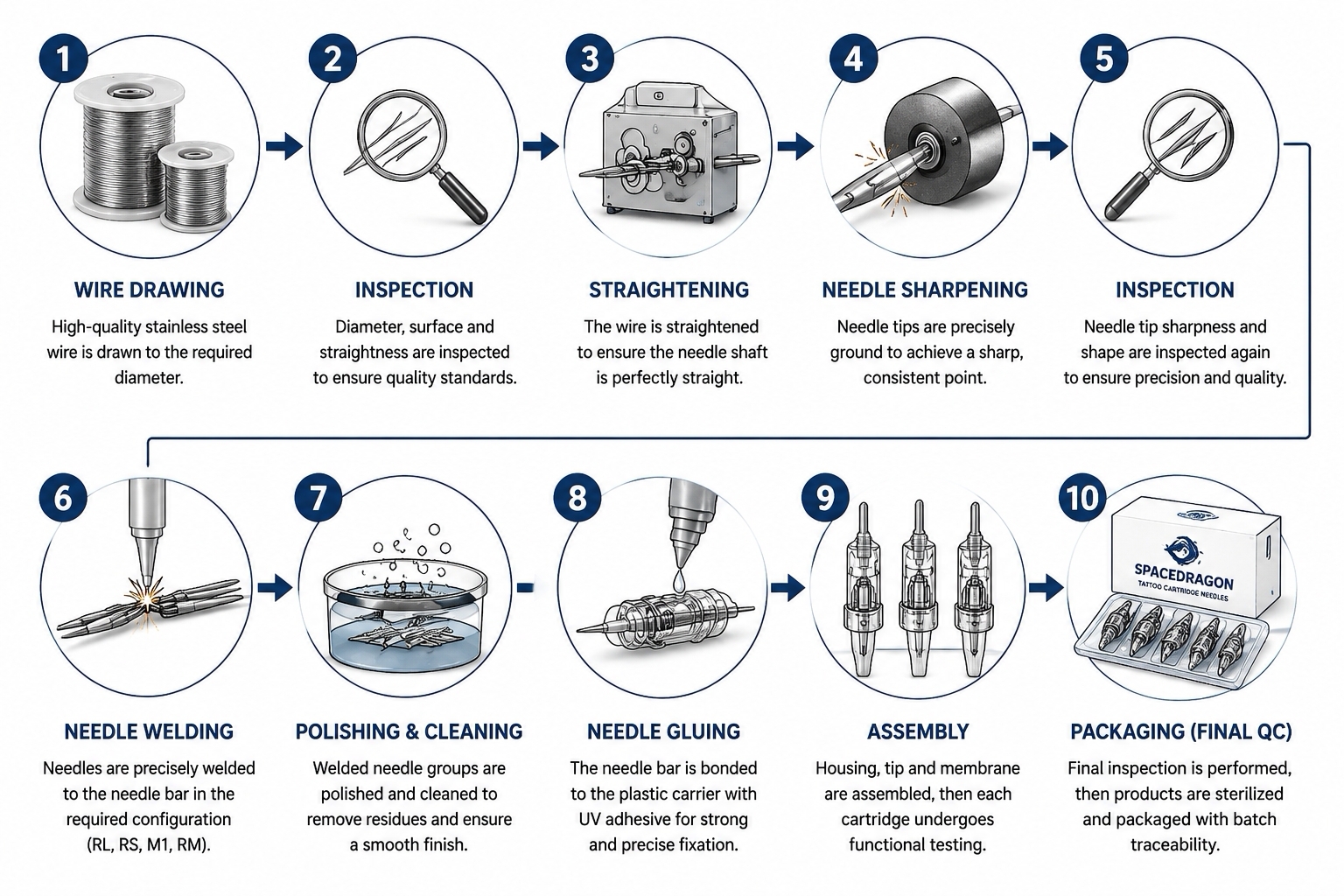
The Birth of a Tattoo Needle: 10 Steps from Stainless Steel Wire to Cartridge
Every clean line and every smooth shade starts with a needle you barely think about.
For tattoo artists, the cartridge needle is the supply you hold in your hand longer than anything else. Snap it into the machine, do the work, throw it away — simple, right? But few people know that a qualified cartridge needle goes through 10 production steps, 4 manufacturing phases, and 3 quality control gates before it ever reaches your studio. This article walks you through the entire journey. By the end, you'll understand why some needles "just work" — and others don't.
Know Your Needles: What Do RL, RS, M1, and RM Mean?
Before we talk production, let's cover a fundamental piece of knowledge. Those needle configuration abbreviations actually describe how the needles are arranged:
- RL (Round Liner): needles grouped tightly into a round point for concentrated ink delivery — the workhorse for lining
- RS (Round Shader): needles in a looser round grouping for softer ink spread — great for small-area shading and color packing
- M1 (Magnum): needles in a single curved row covering a wider area — built for large color fills and smooth transitions
- RM (Round Magnum): needles arranged in a curved arc that follows the skin's contour — even shading with less trauma
Each configuration demands a different level of welding precision — and that's one of the most critical steps in production.
Phase 1: Material Preparation — Great Needles Start with Great Wire
01 Wire Drawing — Everything begins with high-quality stainless steel wire. Through precision wire drawing, the wire is pulled to the exact diameter required for tattoo needles. Tolerance control at this stage determines the consistency of every needle downstream — it's the foundation of the entire production line.
02 Incoming Inspection (QC Gate 1) — Wire doesn't go straight onto the machines. Inspectors check diameter, surface condition, and straightness: dimensional sampling, surface defect detection, and pre-processing quality verification. Substandard wire never gets the chance to become a needle.
03 Straightening — Precision straightening equipment ensures every needle shaft is perfectly straight. Don't underestimate this step: shaft straightness directly affects needle stability during tattooing. A needle that isn't straight will "wander" when you line.
Phase 2: Needle Forming — Where Sharpness and Precision Are Born
04 Needle Sharpening — Needle tips are shaped through precision grinding. The grinding process defines tip geometry — different configurations call for different point angles. A well-ground tip enters the skin with less resistance and a cleaner puncture, so pigment settles evenly and stays put.
05 Tip Inspection (QC Gate 2) — After grinding, tip shape and sharpness are inspected again, batch by batch. This is a gate dedicated entirely to sharpness, ensuring every needle delivers consistent penetration performance.
06 Needle Welding (Configuration Welding) — This is where individual needles become a needle group: multiple needles are precisely welded to the needle bar according to RL, RS, M1, and RM arrangement specifications. Arrangement accuracy and weld strength determine how stable the group stays under high-frequency vibration. A poorly welded group can spit ink, wobble, or even snap mid-session.
Phase 3: Finishing & Assembly — From Components to Product
07 Polishing & Cleaning — Welded needle groups are polished and cleaned to remove processing residues and achieve a smooth surface finish. The smoother the needle, the smoother it runs — and the less it drags or pools ink.
08 Needle Gluing — The needle bar is bonded to the plastic carrier with precisely applied UV adhesive. Glue position accuracy and bond strength determine product reliability over long working sessions.
09 Assembly — Housing, tip, and the membrane are assembled here, followed by a functional check. The membrane may be small, but it's the critical safety component that stops ink and fluids from backflowing into your machine.
Phase 4: Packaging — The Final Gate
10 Packaging (Final QC) — Finished products go through final inspection in a controlled environment, then move into sterile packaging. Every batch carries traceability management — meaning any pack can be traced back to its exact production batch if an issue ever arises.
Now That You Know the Process, You Know How to Choose
Understanding these 10 steps gives you a yardstick for picking cartridges:
- Check the tip: a good needle has a sharp, uniform, burr-free tip — a direct result of grinding quality and QC Gate 2
- Check the grouping: neat arrangement and clean weld points mean high configuration-welding precision
- Check straightness: a perfectly straight shaft keeps your lines stable
- Check the membrane: a reliable backflow membrane is non-negotiable for safety
- Check the packaging: sterile individual packaging with batch identification is the baseline of any serious manufacturer
Final Thoughts
From a spool of stainless steel wire to a sterile-packed cartridge, every needle passes through 10 tightly controlled steps and 3 strict quality gates. Tattooing is the art of drawing on skin — and the needle is the brush. The precision of that brush always ends up in the work.
Next time you snap a cartridge into your machine, you might feel a little more respect for this tiny consumable.
Read the full manufacturing process: www.spdra.com
FAQ
How are tattoo cartridge needles manufactured?
Tattoo cartridge needles are manufactured through several steps including stainless steel wire drawing, sharpening, welding, polishing, assembly, sterilization, and final quality inspection.
Are tattoo cartridge needles sterile?
Professional tattoo cartridge needles should be individually sterilized and packaged with batch traceability information to ensure safe professional use.
What is the difference between RL, RS, M1, and RM tattoo needles?
RL needles are designed for precise lining, RS needles provide softer shading, M1 needles cover larger areas, and RM needles offer smooth curved shading performance.
Does Spacedragon provide OEM tattoo cartridge needles?
Yes. Spacedragon provides OEM and ODM tattoo cartridge needle manufacturing services for tattoo brands, distributors, and professional suppliers worldwide.