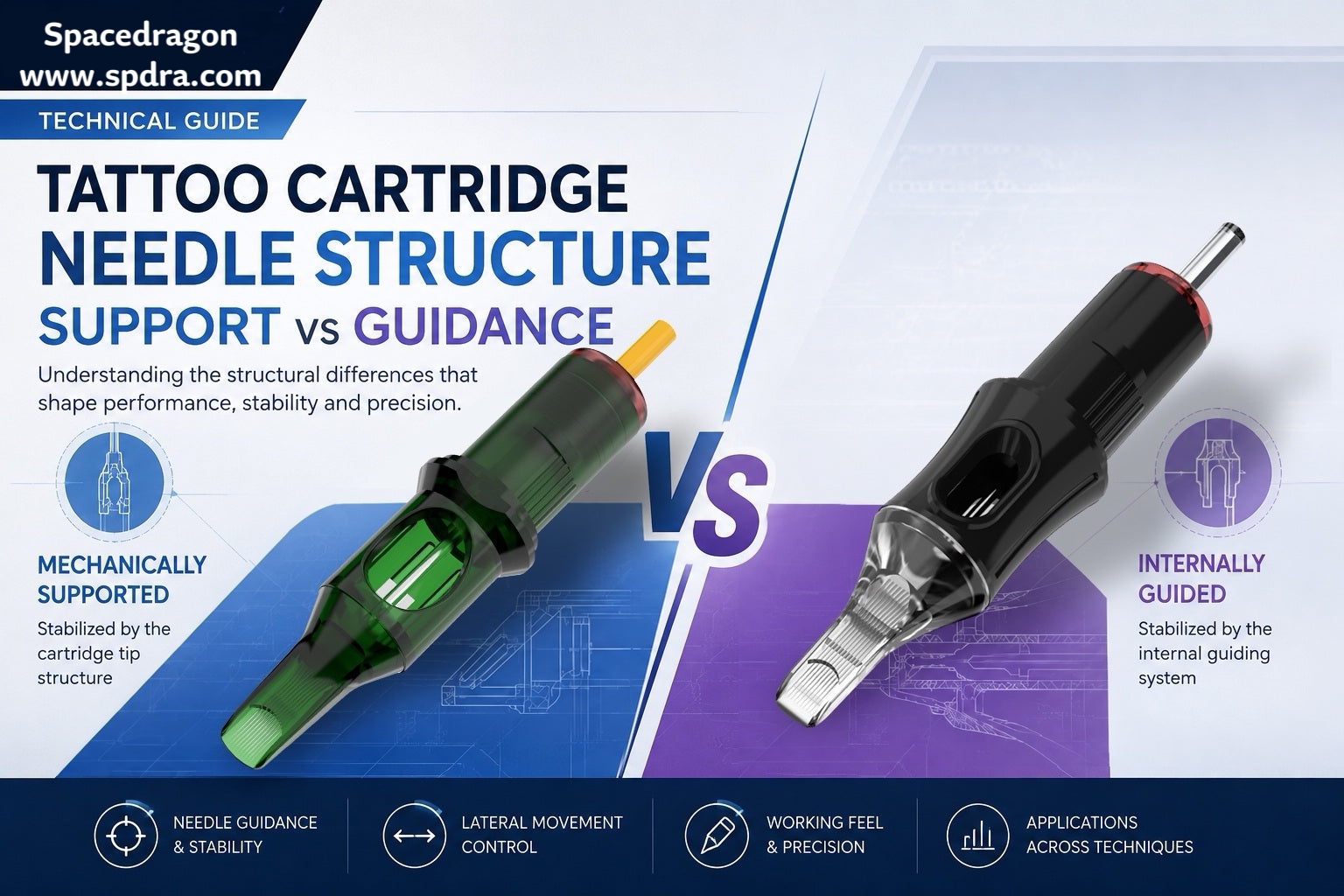
Tattoo Cartridge Needle Structure Explained: Mechanical Support vs Internal Guidance
Understanding How Cartridge Engineering Affects Needle Stability, Movement Control, and Tattoo Performance
Most tattoo cartridge needles may appear simple from the outside — a housing, a needle group, a membrane system, and a connection to the tattoo machine.
However, inside every professional tattoo cartridge is a carefully engineered mechanical system. The position of support points, the way the needle bar is guided, and how reciprocating movement is controlled all influence the cartridge’s stability, response, and working performance.
At Spacedragon Tattoo, we specialize in precision manufacturing of tattoo cartridge needles, PMU cartridges, and SMP cartridges. Through continuous product development and manufacturing experience, we focus on improving cartridge consistency, needle alignment, and overall user experience for professional artists, distributors, and OEM/ODM partners worldwide.
For professional tattoo artists and cartridge developers, needle configuration is only one part of cartridge performance. Round liner, round shader, magnum, curved magnum, needle diameter, taper, and needle count are important, but internal structure also plays a critical role.
Factors such as:
- Needle guidance
- Lateral movement control
- Component tolerance
- Friction between moving parts
- Needle bar alignment
- Cartridge housing design
all influence how a cartridge performs during tattooing.
This article explains two important structural approaches used in tattoo cartridge engineering:
- Mechanically Supported Needle Structure
- Internally Guided Needle Structure
Both designs aim to control repeated needle movement, but they achieve stability through different mechanical principles.
What Happens Inside a Tattoo Cartridge During Operation?
A tattoo machine converts motor movement into rapid reciprocating motion.
This movement is transferred through the cartridge connection to the needle bar, causing the needle group to repeatedly extend and retract through the cartridge tip.
Ideally, the needle should move along a stable forward-and-back axis. However, in a real mechanical system, small movement variations can occur due to:
- Component clearance
- Needle bar flexibility
- Manufacturing tolerance
- Machine alignment
- Working angle
- Membrane resistance
- Internal component interaction
Therefore, tattoo cartridge engineering is largely a process of motion control optimization.
A well-designed cartridge needs to achieve the right balance between:
- Stable needle movement
- Controlled flexibility
- Smooth reciprocation
- Low unnecessary friction
- Consistent performance between batches
Why Lateral Needle Movement Matters
Lateral needle movement refers to movement away from the intended forward-and-back direction.
A certain amount of clearance is necessary for smooth mechanical operation. However, how this clearance is controlled directly affects the cartridge’s working feel.
A structure with additional support points may provide a more controlled and stable needle response.
A structure with internal guidance may provide a different balance between responsiveness and flexibility.
Neither design is automatically better. The ideal structure depends on:
- Tattoo technique
- Machine setup
- Artist preference
- Needle configuration
- Intended application
This is why professional cartridge design focuses not only on needle grouping, but also on the complete mechanical system.
1. Mechanically Supported Needle Structure
Enhanced Mechanical Stability for Precision Techniques
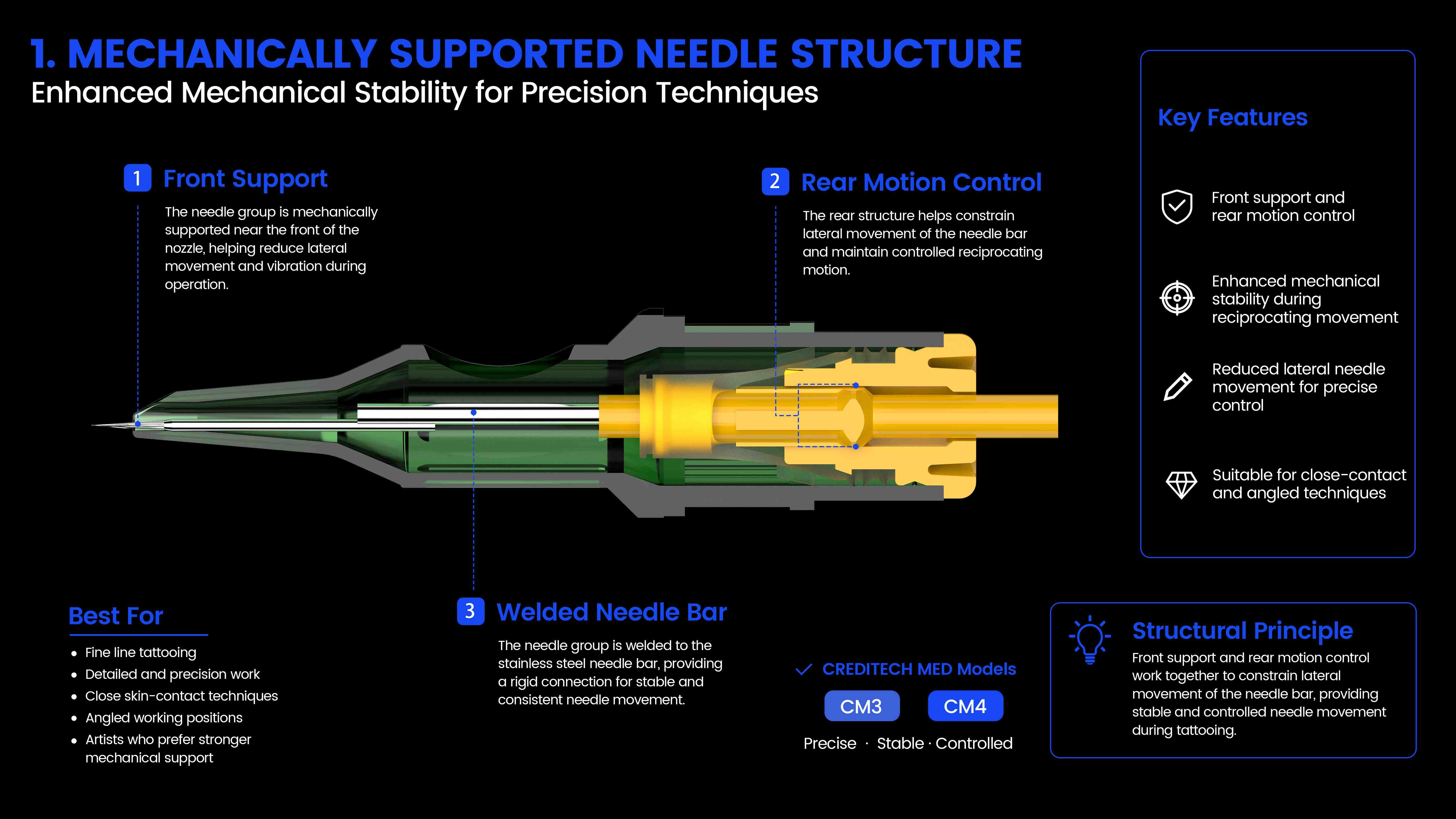
In this design approach, front support works together with rear motion control and a welded needle bar structure to create a more mechanically controlled movement path.
Front Support: Controlling Needle Movement Near the Nozzle
The front support area provides additional mechanical guidance near the cartridge tip.
By helping restrict unnecessary lateral movement, this structure can improve:
- Needle stability
- Movement consistency
- Precision during close-contact techniques
For detailed tattoo work, fine lines, and artists who prefer a more controlled cartridge response, mechanical support can provide a different working experience.
Rear Motion Control: Maintaining Needle Bar Stability
Needle movement is influenced not only by the cartridge tip but also by the rear drive section.
Rear motion-control design helps manage side-to-side movement while maintaining the required forward-and-back motion.
Together, front support and rear control create a more guided movement path.
Welded Needle Bar: Reliable Motion Transfer
The welded needle bar creates a stable connection between the needle group and the driven assembly.
From a manufacturing perspective, this requires precise control of:
- Needle positioning
- Welding consistency
- Alignment accuracy
- Assembly quality
At Spacedragon, manufacturing consistency is a key focus when developing cartridge structures for professional applications and OEM projects.
Typical Applications
Mechanically supported structures are commonly suitable for:
- Fine line tattooing
- Detailed artwork
- Precision outlining
- Close skin-contact techniques
- Artists who prefer stronger mechanical feedback
2. Internally Guided Needle Structure
Efficient Internal Guidance for Versatile Tattoo Applications
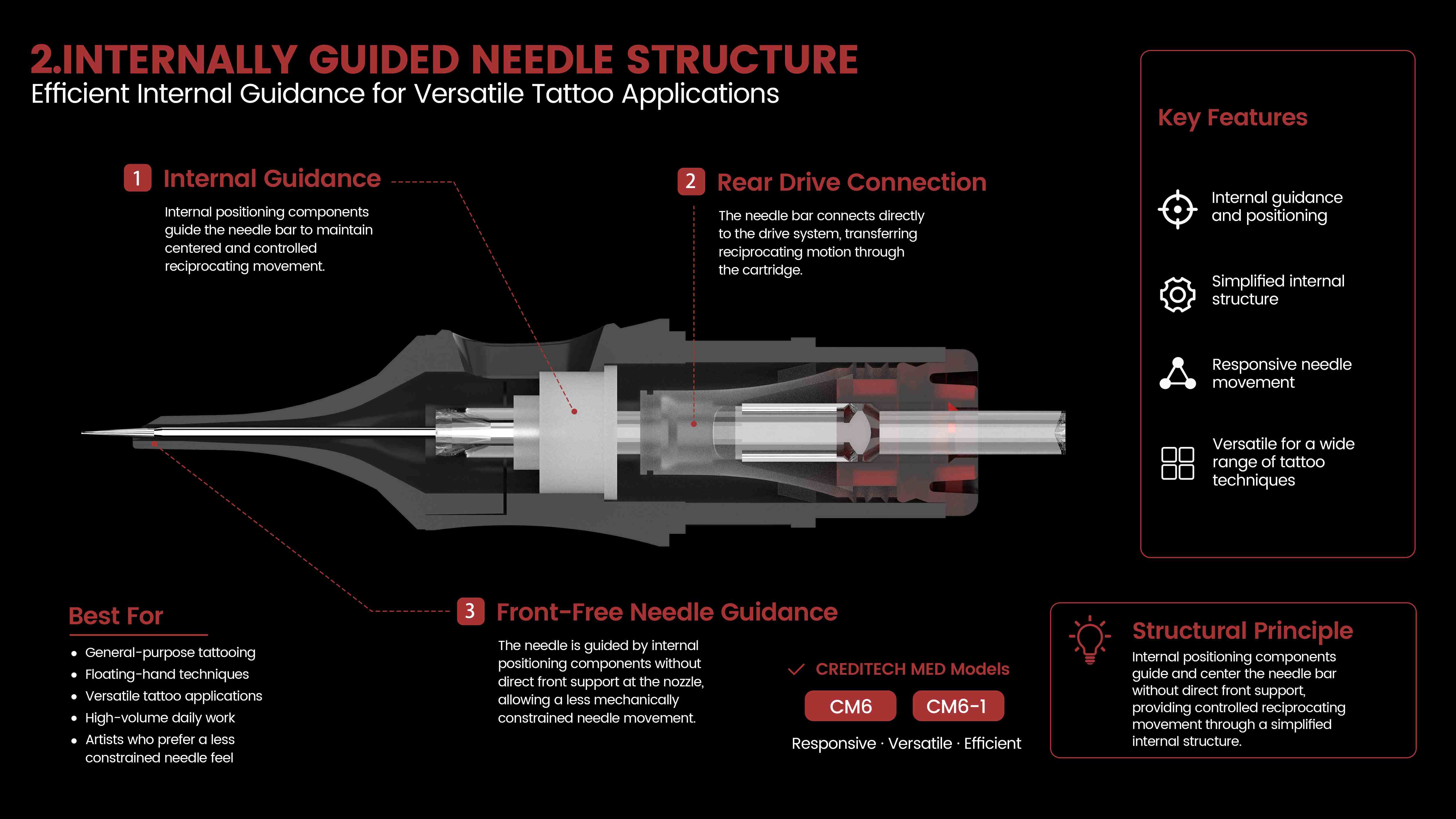
An internally guided structure controls needle movement through internal positioning components rather than direct front mechanical support.
The goal is the same: maintaining accurate needle movement while balancing stability and responsiveness.
Internal Guidance: Centering Through Internal Structure
Internal guiding components help maintain the needle bar’s intended movement path.
This design relies on:
- Internal positioning
- Component geometry
- Dimensional accuracy
- Manufacturing consistency
Instead of using direct front support, guidance is achieved through internal structural control.
Rear Drive Connection: Transferring Machine Movement
The rear section connects the cartridge assembly with the tattoo machine drive system.
Proper alignment ensures that reciprocating motion is transferred efficiently through the cartridge.
Front-Free Needle Guidance
Without direct front support near the nozzle, the needle assembly can have a different movement characteristic.
This type of structure may provide:
- Responsive needle movement
- Versatile working feel
- Flexibility for different tattoo techniques
Typical Applications
Internally guided structures are suitable for:
- General tattoo applications
- Floating-hand techniques
- Versatile tattoo styles
- High-volume daily work
Mechanical Support vs Internal Guidance: Which Structure Is Better?
There is no universal answer.
These two designs represent different engineering approaches.
| Feature | Mechanically Supported | Internally Guided |
|---|---|---|
| Main control method | Physical support points | Internal positioning system |
| Needle movement | More controlled | More responsive |
| Structure focus | Stability and precision | Flexibility and versatility |
| Suitable applications | Fine line, detailed work | General tattooing, floating-hand techniques |
The best cartridge depends on the intended application and artist preference.
Cartridge Structure and Manufacturing Consistency
A good cartridge design is not only about the concept.
Consistent performance requires control over every production step:
- Housing dimensions
- Needle bar alignment
- Internal component tolerance
- Membrane performance
- Assembly accuracy
- Quality inspection
At Spacedragon, we combine engineering development with manufacturing control to provide reliable tattoo cartridge solutions for global tattoo brands and distributors.
OEM & ODM Tattoo Cartridge Development with Spacedragon
For private-label brands and distributors, cartridge selection involves more than choosing colors or packaging.
A successful cartridge project requires consideration of:
- Structural design
- Needle configuration
- Housing customization
- Membrane system
- Manufacturing process
- Packaging solution
- Market positioning
Spacedragon provides OEM and ODM support for:
- Tattoo cartridge needles
- PMU cartridges
- SMP cartridges
- Private label tattoo products
From product concept to mass production, we help partners develop cartridge solutions designed for their target markets.
Conclusion: Cartridge Engineering Defines Performance
The visible part of a tattoo cartridge is only the beginning.
Inside the cartridge, support structures, internal guides, needle bar connections, and manufacturing tolerances determine how the needle moves and how the cartridge performs.
Mechanically supported structures focus on controlled stability.
Internally guided structures focus on balanced movement and versatility.
For tattoo artists, distributors, and OEM buyers, understanding cartridge structure helps make better decisions when selecting or developing professional tattoo cartridge needles.
At Spacedragon Tattoo, we continue to develop precision-engineered cartridge solutions that combine manufacturing expertise, structural design, and customization capability.
Spacedragon Tattoo — Professional Tattoo Cartridge Needle Manufacturer & OEM Partner Since 2009.
Contact Spacedragon Tattoo
Brand: Spacedragon Tattoo
Manufacturer: Creditech Med
📧 Email: mira@spdra.com
📱 WhatsApp / WeChat: +86 13606216251